
Torrance County VINELink Coverage
VINELink is the web access point for New Mexico VINE, a free custody-information and notification service. The state describes VINE as available online and by telephone around the clock. It can report events such as release, out-to-court status, and escape for a participating criminal-custody record. The research did not verify a complete list proving that every Torrance County booking appears, so search results must be tied to the specific agency record that is actually shown.
New Mexico VINE and NMCD records belong to the state criminal-custody system. Torrance County Detention Facility is chiefly presented in current federal materials as an ICE detention site. For an ICE detainee there, use ICE’s public Online Detainee Locator System and the separate DHS-VINE service. A federal BOP prisoner is outside ordinary VINELink coverage, while a USMS pretrial detainee has no general public prisoner-history locator. The custody agency, not the building name alone, determines which service applies.
| Custody path | Notification or lookup route |
|---|---|
| Participating county criminal record | New Mexico VINE through VINELink, then confirmation with the county or court |
| NMCD prison or supervision record | New Mexico VINE and NMCD Offender Search, subject to the current service notice |
| ICE detention at TCDF | ICE ODLS for public location or recent release, plus DHS-VINE for eligible alerts |
| Federal BOP custody | BOP Inmate Locator, not VINELink |
| USMS pretrial custody | Federal docket or clerk; restricted DOJ VNS only for credentialed victims |
Search Torrance Inmates on VINELink
VINELink works best for a specific person whose active record can be matched before release. A historical search after a record disappears may not recreate the alert or the event. Start with the exact name or agency identifier accepted by the portal. Confirm the facility and any public record number before selecting the result. When multiple matches appear, do not choose solely by name.
- Open VINELink and select New Mexico. Use the state shown for the custody record, not merely the person’s home address.
- Enter the exact name or the agency identifier offered by the live interface. Try a verified spelling variant when the first query fails.
- Compare the facility, status, and safe identifying details. Stop if the record cannot be matched with confidence.
- Open the exact record and read its custody wording without paraphrasing a transfer as community release.
- Record the lookup date and the agency or facility attached to the result. Public custody data can change.
- Register from that matching record if a future notification is needed.
A Torrance County result is only one access channel. For a local criminal booking, the county booking or release sheet and the court order can verify the underlying event. For state custody, the NMCD Offender Search can show incarceration or supervision data and directs users to the relevant institution or Probation and Parole office for confirmation. The Torrance County released-inmate lookup maps those routes by custodian.
Note: A no-result can reflect spelling, a transfer, system timing, a nonparticipating record, or a custody system that VINELink does not cover.
Torrance VINELink Release Results
A VINE result should be summarized as a custody-status report for a participating record. Do not promise a booking photo, release reason, destination, full case history, or exact date unless the live record visibly provides that field. New Mexico’s state material supports custody and notification functions, but the research did not capture a lawful live person result or a fixed public data dictionary.
| Possible field or signal | Safe interpretation |
|---|---|
| Name or agency identifier | Helps match the particular custody record; it is not enough alone for a common name |
| Facility or custodian | Identifies which participating record reports the status |
| Custody-status language | Must be quoted or paraphrased narrowly as the service displays it |
| Release or status event | Shows that the participating record reported a change, not that every custodian released the person |
| Notification options | Shows which phone, text, or email channels the current interface offers |
A “released” label ends only the listed custody episode. The person may have transferred to another jail, NMCD, ICE, USMS, or another authority. The county release sheet or court order can explain the disposition. For immigration detention, an ODLS recent-release result can mean release from ICE custody, yet conditions and check-ins may continue.
Register Torrance County Release Alerts
Register while the correct record is active. New Mexico VINE allows phone, text, and email notification, with more than one telephone number if needed. Telephone alerts use a four-digit PIN. The current NMCD page says calls may repeat until the PIN confirms receipt or for up to 48 hours. An older state brochure says 24 hours, so the current live instructions control.
- Open the matching VINELink record or call New Mexico VINE at 877-551-8463.
- Choose the offered phone, text, or email method. Add another phone number if the service permits and that improves notice.
- Enter the requested contact information with care. An incorrect digit or address can prevent delivery.
- Create a four-digit PIN for calls and keep it available to the intended recipient.
- Confirm the registration and save its details with the person’s correct custody record.
- When a call arrives, enter the PIN to acknowledge the notice and stop repeat attempts.
- Use Update Registration when contact details change rather than creating an unrelated duplicate.
An alert is a prompt to verify. Save the event time and wording, then contact the releasing agency if the difference between transfer and release to the community matters. A notification cannot supply facts that the participating record does not include.
Torrance VINELink Transfer Re-Registration
New Mexico has a notable custody-boundary rule. A registration does not simply follow the person through every transfer. When someone moves from one county jail to another, or from a county record into NMCD, the registrant must enroll on the receiving record. Otherwise, a later release event can occur outside the first alert subscription.
This is especially important in Torrance County, where one person’s route may cross a county booking, contracted detention space, state prison, or immigration custody. First determine whether the earlier VINE event was release or transfer. Then find the receiving agency. Re-register only after matching the new record, and retain the prior alert so the chain of custody remains clear.
VINE registration is also separate from formal written notice available to certain victims under New Mexico law. Enrollment on VINELink does not register an eligible victim for NMCD or Parole Board written notices. That process runs through the prosecuting district attorney.
Note: Re-registration protects the alert path after a transfer, but each new record still must be matched independently.
Torrance NMCD VINE Upgrade
The NMCD VINE information page carried a time-sensitive upgrade notice at the research date. It said NMCD offender searches, new registrations, and some notifications were unavailable during the upgrade, while existing NMCD release notifications continued. The page pointed users to NMCD Offender Search and interim telephone contacts. The notice must be rechecked before use because service status can change.
The official NMCD page below captures the state’s instructions and its posted service limitation.
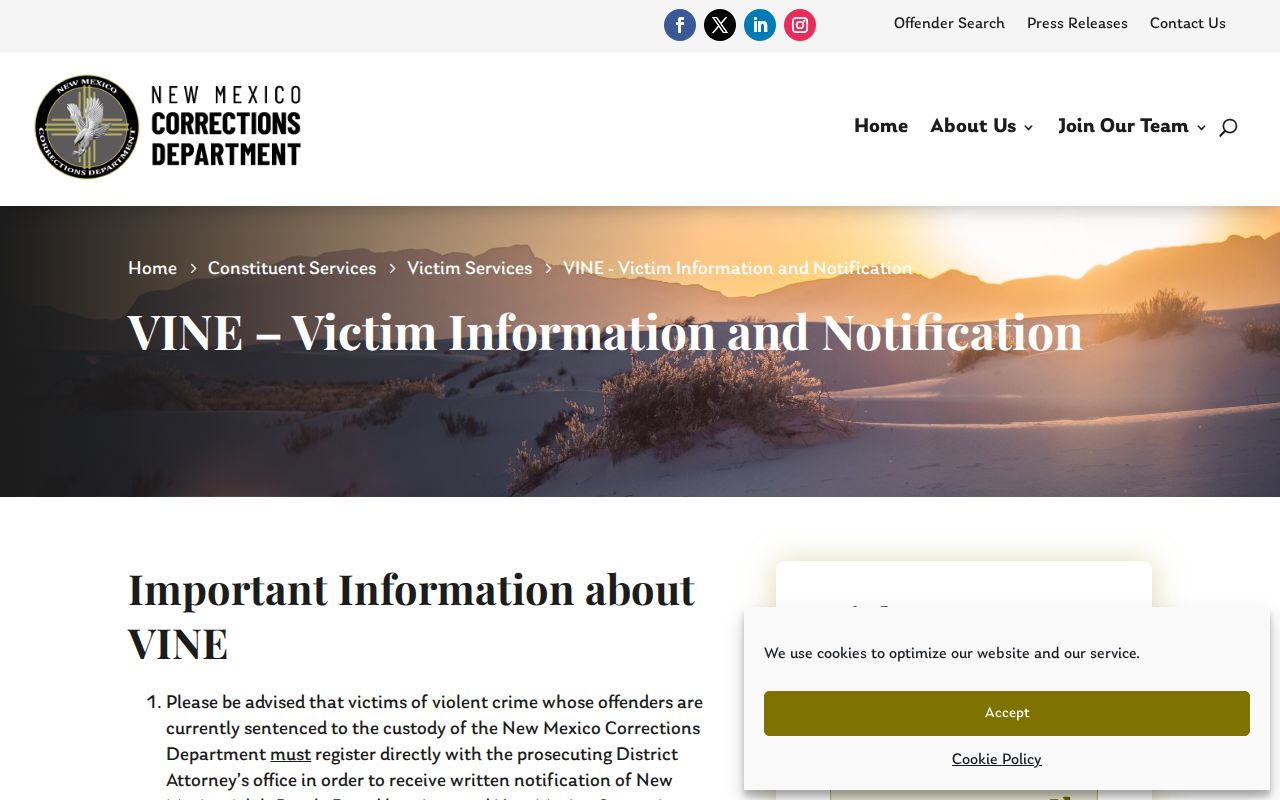
During an NMCD outage, search the state offender record, allow for its stated update timing, and verify with the relevant institution or Probation and Parole office. Interim numbers posted by NMCD were 505-827-8848 and 505-288-2535. Existing release alerts were said to continue, but that does not mean new registrations succeeded.
Torrance DHS-VINE Release Alerts
DHS-VINE is separate from New Mexico VINE. It is designed for eligible victim and witness custody-change notifications in the immigration system. A person held at Torrance County Detention Facility under ICE authority should not be placed into the NMCD alert path merely because the facility is in New Mexico.
For public immigration location or recent-release information, begin with ICE ODLS. It searches by exact A-number and country of birth, or exact name with country and date of birth. ICE says it includes current detainees and people released from ICE custody within the last 60 days. DHS-VINE then serves the distinct notification role for those eligible to use it. ODLS is a locator, not an alert subscription or complete immigration history.
A DHS-VINE event does not settle a criminal case or NMCD status. Similarly, a New Mexico VINE result does not establish an ICE release. Keep the source label with every saved notice so a later reader knows which custodian reported the change.
Confirm Torrance VINELink Releases
Verification starts with the agency named on the alert. For a Torrance County criminal booking, request the existing release entry or booking sheet from the county and examine the court register for a release order, bond change, judgment, dismissal, or later warrant. For an NMCD record, compare the offender search and contact the listed institution or Probation and Parole office. The public landing page says prison data updates nightly and can take 24 hours to appear, while supervision data is described as real time.
For ICE at TCDF, compare ODLS with ERO information and the person’s release paperwork. A release can carry check-in terms. A transfer remains custody, and removal from the United States is not the same as release into Estancia. For BOP, use the federal locator; for a USMS pretrial matter, use the federal court order because no public USMS history locator exists.
The strongest conclusion combines the VINE event with an independent record. State exactly what each source proves. “VINE reported a custody-status change” is sound. “The person is free everywhere” is not.
Note: Preserve the lookup date, facility name, record identifier, and exact status wording when documenting a Torrance County alert.