
BOP Federal Release Paths
BOP institutions hold sentenced federal prisoners. They are distinct from USMS pretrial custody and ICE civil detention. A person can leave a BOP institution through release at sentence completion, movement to residential reentry placement, transfer to another federal institution, or delivery to another custodian. A past release date shows when BOP custody ended, not where the person went next.
No BOP prison was identified in Torrance County. Location is still not the key test. A person prosecuted in federal court in New Mexico may be assigned to an institution elsewhere in the nation. Keep the federal case number and BOP register number. Those identifiers link the court and prison trails even when the institution changes.
| BOP result | Safe interpretation |
|---|---|
| Named institution | The record points to current or reported BOP placement |
| Future release date | A scheduled date that may change |
| Past release date | BOP custody ended on that recorded date |
| Released / Not in BOP Custody | BOP no longer holds the person; other custody is not ruled out |
Confirm a BOP Release
The BOP Inmate Locator accepts four kinds of number: BOP register, DCDC, FBI, and INS. It also supports a name search with optional age, race, and sex fields. A number search is the strongest identity match. Name-only results should be checked against the register number and federal case record.
- Search the known BOP, DCDC, FBI, or INS number before relying on a name.
- If using a name, add the optional identity fields to narrow the result.
- Compare the name, register number, age, and other displayed details.
- Read the institution or status and release date together.
- Check the federal docket for sentencing, release, or later custody orders.
- Follow a named receiving authority when the federal record indicates transfer.
Results can display name, register number, age, race, sex, release date, and location or status. A past date with no institution is useful evidence about BOP custody only. Federal sentence dates can be recalculated, including through statutory changes. Save the retrieval date and do not treat a future date as an unchangeable promise.
If a number search and name search point to different people, stop and reconcile the identifiers. Federal docket records often state the defendant’s case number and sentence, while the BOP result supplies the register number. Match them through official records. Do not publish extra personal details merely to show that a match was made. The goal is custody verification, not a profile.
BOP Release Record Coverage
BOP locator records are strongest from 1982 forward. Older federal-prison records may require a National Archives route. This date boundary matters when a historic name search fails. It does not prove that the person was never federally incarcerated, and it should not be filled with data from an unofficial source.
The locator is a status and date tool, not a full discharge certificate or criminal docket. The federal court file supplies the judgment and later orders. A records request may be needed for an agency document outside the public locator. Record age, privacy law, and the requester’s authority can affect disclosure.
A historic released label can remain useful long after the person leaves prison. It should be captured with the search date and register number. For an old record outside the locator’s main coverage, provide the National Archives with the known name, dates, institution clues, and federal identifiers. Do not fill the gap with a commercial roster or assume that no online match means no federal record.
- Register number
- The BOP identifier used to distinguish federal records.
- Residential reentry
- A structured placement that can follow prison confinement before full release.
- Projected date
- A date subject to computation and later legal or administrative change.
- Release date
- The date BOP records the end of its custody episode.
Note: For pre-1982 federal custody, preserve all known identifiers before asking the National Archives for the older record.
BOP Release Records Contact
Because BOP is a nationwide system, a single Torrance County prison contact does not exist. Use the institution named on the matching result for present placement questions. Use the locator and federal docket for a released person. The BOP record page explains how its release labels should be read and why a historical result can remain visible.
Federal Bureau of Prisons
Nationwide federal prison system
Public route: BOP Inmate Locator
Institution contact: use the facility named in the matching result
Historic older records: National Archives when applicable
A Torrance County address or local arrest does not place someone in BOP. A federal judgment and BOP intake do. Likewise, a USMS detainee held before trial may never appear in BOP if no federal prison sentence follows.
Residential reentry can be another source of confusion. Movement from a secure institution to a reentry placement is a change in location and conditions, but it may remain part of the federal sentence administration. Report the public BOP label as shown. Do not call the move full discharge unless the record supports that conclusion.
Read BOP Release Labels
The BOP locator-record explanation describes the meaning of release dates and post-custody labels.
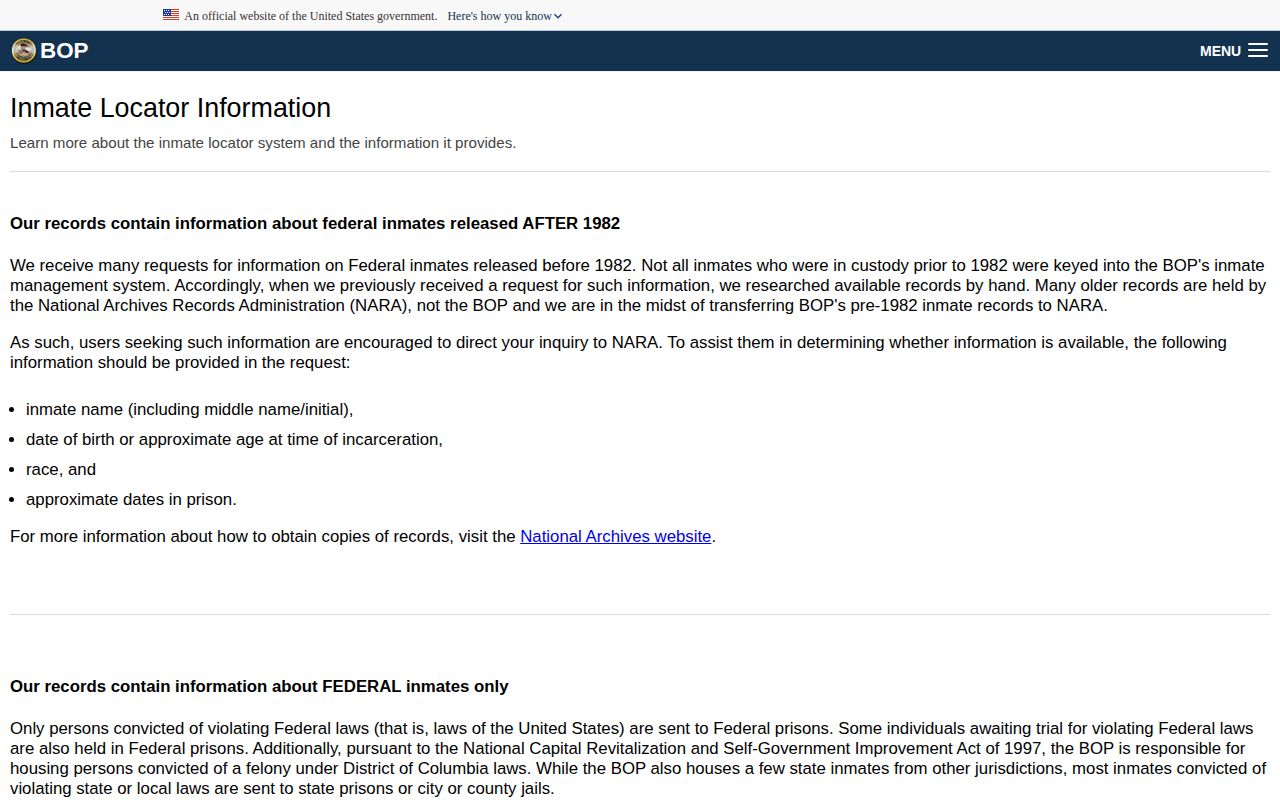
The official explanation supports a narrow finding that BOP custody ended, while the docket and other locators address any later authority.
BOP Release Date Changes
A federal release date can move. The sentence imposed by the court is the start of the review, not the end. Prior-custody credit, consecutive or concurrent terms, earned credits, later court orders, and statutory recalculation can affect the date. The BOP locator reflects the agency’s current public computation, while the docket supplies the filed judicial record.
Do not estimate a release by simple calendar arithmetic. Compare the latest locator value with the latest judgment or sentence modification. When the person has already left, use the recorded past date rather than an old projection. A transfer to residential reentry or another custodian should be described as recorded, without assuming unrestricted community release.
The federal docket can also reveal supervised release, a term that usually follows imprisonment and imposes court-ordered conditions. It is not the same as BOP custody, and it is not the same as state parole. A person may be “Not in BOP Custody” while still subject to federal supervision. Use the docket and responsible federal office for the terms and current legal record.
BOP and Torrance Custody
The federal prison search is one branch of the mixed-custody decision tree. A New Mexico state case belongs in the court and NMCD systems. A local booking belongs with TCSO and the state court. Immigration custody at TCDF belongs first in ICE ODLS. Federal pretrial custody belongs in the federal docket and USMS pathway.
The Torrance County release search helps compare those branches. The physical building or county name is not enough to choose a locator. Ask which government had legal custody, then use that agency’s record and a second independent source.
Federal and immigration number fields can look alike, but their use differs. An INS number may assist a BOP locator search for a federal prison record, while an A-number belongs in ICE ODLS for civil immigration custody. A match in one system does not establish the status of the other. Keep the source name beside every date and label.
For a person first held by USMS, the federal docket can show detention before any BOP intake. A delay between sentencing and locator appearance may reflect designation or transport. Return to the clerk when the public systems seem out of sequence. The court order and the later BOP record can describe consecutive parts of one federal case without contradicting each other.
A historic BOP date also needs a retrieval note. BOP explains that a past release date with no institution means the person is no longer in BOP custody. It does not state that supervision ended or identify a later jail, state prison, or immigration action. Save the register number, displayed label, date, and search date. Then compare the federal docket for supervised release or a later order. For records before the locator’s main post-1982 coverage, use the National Archives path rather than filling the gap with an unofficial federal inmate page.
No local Sheriff roster can confirm a nationwide BOP discharge. In the same way, BOP cannot certify the end of a New Mexico sentence or an ICE matter. The scope statement is part of the finding: BOP held the person until the date shown, or BOP reports that it no longer holds the person. Anything broader needs another record.