
Torrance Projected Versus Actual Release
A projected date is a working calculation based on the facts known to the custodian. It may reflect the court-imposed term, lawful presentence credit, whether terms run at the same time or one after another, and credits actually earned and retained. It remains conditional. An actual release date is the timestamp recorded after the person leaves that custodian, along with a disposition such as discharge, parole, transfer, or release to another authority.
A pretrial detainee is different. Before sentence, there is no prison term from which to subtract credits. Release may depend on bond, a court order, dismissal, or a later hearing. A docket date is not a projected release date. Even after sentence, a transfer to NMCD, ICE, another jail, or federal custody is not release into the community.
Torrance County also has a mixed-custody trap. The detention facility in Estancia can hold people under different authorities, while New Mexico state prisoners are held at NMCD institutions outside the county. The physical building does not establish whose calculation controls. Name the custodian before trusting any date.
Find Torrance Projected Release Dates
Begin with the source that created the custody term. For a New Mexico state sentence, use the judgment and NMCD records. For a local sentence or pretrial matter, use the Torrance court file and the local custody record. For ICE, BOP, or USMS custody, switch to the federal route. Searching the wrong system can return nothing even when the person is still held elsewhere.
- Identify the custodian for the episode: Torrance County, NMCD, ICE, BOP, or USMS. Use the case number and booking or agency number when available.
- Obtain the filed judgment, sentence, detention order, release order, or bond order from the court that issued it.
- For an NMCD sentence, search the person by name or NMCD number and read only fields the live result actually displays.
- For a county sentence, ask the county custodian for the existing custody calculation or release entry and compare it with the court order.
- Check for amended orders, presentence credit, concurrent or consecutive terms, parole action, and holds from another authority.
- Confirm the date with the institution or agency responsible for the legal status. Record the date and source of the confirmation.
- After release, replace the prediction with the actual release or transfer record.
The Torrance County released-inmate search explains the county, court, state, immigration, and federal paths after the event. For a pending alert tied to a participating criminal-custody record, the VINELink Check explains registration and service limits.
Note: A date derived from sentence arithmetic is an estimate until the responsible custodian confirms its own computation.
Torrance NMCD Release Date Search
The NMCD Offender Search accepts a first name, last name, or NMCD number and covers people incarcerated by NMCD or under NMCD probation or parole supervision. It expressly does not cover county or city detention facilities. Adult Prison Division data updates nightly and may take 24 hours to appear. Probation and Parole data is described as real time.
No projected or tentative release-date field was verified on the public NMCD result interface during the research. Do not import a field label from another state or promise that every record supplies one. If the live result displays a date, copy its exact label and note the lookup date. The landing page also says Central Office, Constituent Services, and the Records Bureau will not provide release updates or statuses. The supported route is the search plus verification with the listed institution or Probation and Parole office.
The official live search illustrates the available input and status controls.
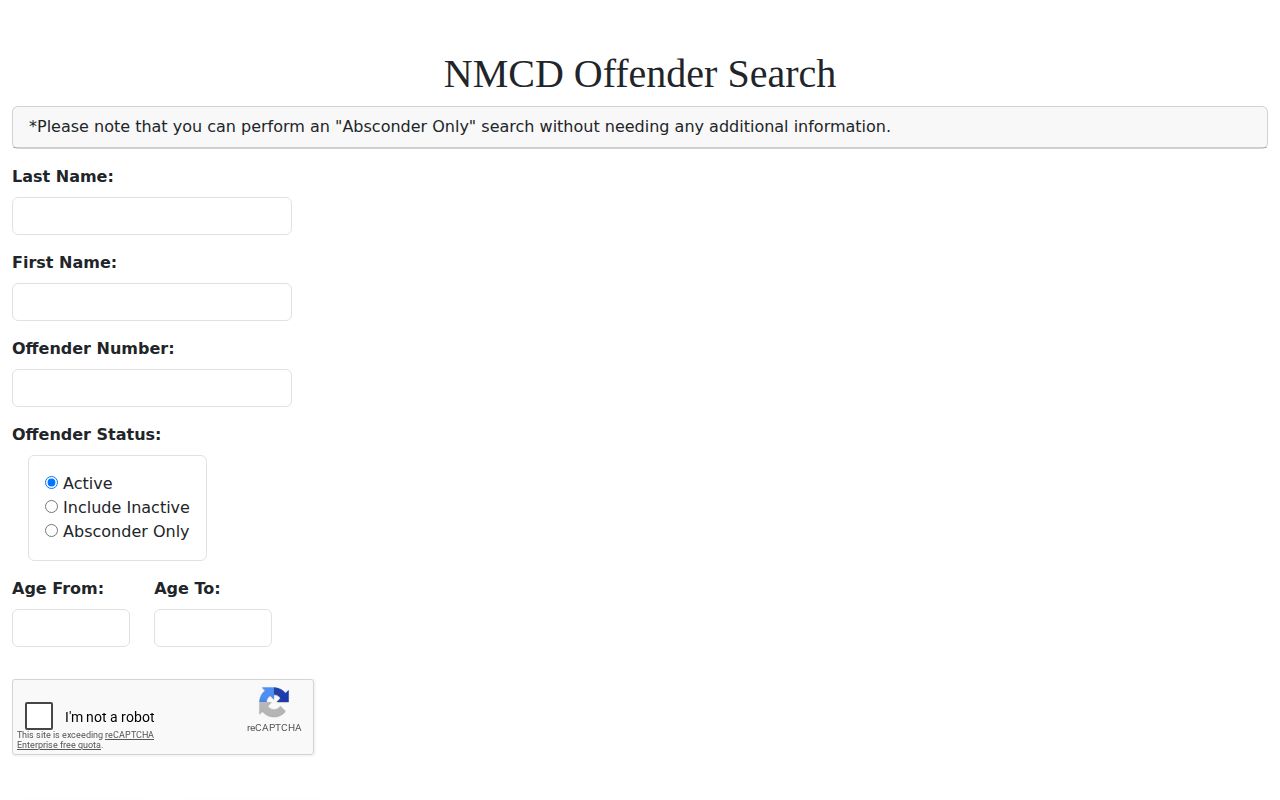
| Search control | Use and limit |
|---|---|
| Last Name | Searches the entered surname; spelling variants may need separate attempts |
| First Name | Helps narrow a name match but should be checked with another identifier |
| Offender Number | Best direct identifier when a verified NMCD number is available |
| Active | Focuses on current records and can omit a former prisoner or supervisee |
| Include Inactive | Useful for a past record; inactive does not itself state an actual release date |
| Absconder Only | Searches an alleged supervision status, not present physical custody |
NMCD warns that technical problems can make a prior result disappear. Absence is not proof of release. Repeat the search, use Include Inactive for historical work, and confirm with the institution or office that holds the current record.
Torrance Release Credit Source Stack
A responsible NMCD estimate uses three kinds of source together. The filed court judgment supplies the imposed term, count structure, and presentence credit. NMSA 1978 §33-2-34 supplies earned meritorious deduction authority and rate categories. Current NMCD policy supplies the administrative process for earning, applying, forfeiting, or restoring deductions. None can answer the whole question alone.
The strongest current agency references in the research are the NMCD policy index, CD-080400 on Earned Meritorious Deductions, CD-080600 on Meritorious Deductions, and CD-055000 on Earned Meritorious Deductions for Parolees. Policy revision dates and current statutory text should be checked at publication. A later amendment or revised policy can affect a calculation.
A safe conceptual expression is: the court-imposed term, adjusted for lawful presentence credit and concurrent or consecutive structure, minus credits actually earned and kept under the applicable law, then adjusted for later court and agency actions. This is not a public calculator. It leaves out no known category on purpose, but each category must be resolved from the actual record.
- Presentence credit
- Lawful credit for qualifying custody before the sentence is imposed.
- Concurrent terms
- Sentence terms ordered to run at the same time.
- Consecutive terms
- Sentence terms ordered to run one after another.
- Detainer
- A request or hold from another authority that can affect where a person goes next.
Torrance Release and 85 Percent
New Mexico’s “85 percent” shorthand is not a universal truth-in-sentencing rule. Its source is the historical limit of four earned-deduction days per month for a serious violent offense. Four days compared with a month produces a rough percentage, but that rough number cannot be subtracted from every sentence.
Section 33-2-34 makes the rate depend on offense classification and eligibility. The conviction date, judgment, exclusions, participation, disciplinary history, and forfeiture or restoration of credits also matter. Life sentences, habitual enhancements, certain sex-offense provisions, parole revocation, and amended judgments can follow different paths. A flat 15 percent reduction would ignore those controls.
This distinction is especially important for Torrance County. Local jail time is not automatically computed under NMCD’s prison-credit policy. Bond and dismissal are not “good time.” A county sentence requires the court judgment and local custody calculation. Prison release credits and possible credits against a parole term are separate computations under separate policy material.
Note: The four-days-per-month history explains the shorthand, but it does not establish any individual Torrance County release date.
Torrance County Release Calculations
A person awaiting trial on a Torrance state case may leave through bond, recognizance or conditions, dismissal, or a court release order. Those events do not arise from NMCD earned-deduction arithmetic. A short local term may include time-served credit, but no Torrance-specific county jail good-time rule was verified. Weekend or holiday release practices were also not verified and should not be stated.
For a local state case, examine the New Mexico court register in date order. A release order can precede a later bench warrant. A judgment may suspend part of the term. Probation may follow confinement. District Court handles felony and general-jurisdiction matters, while Moriarty Magistrate handles misdemeanor, DWI, traffic, and felony preliminary proceedings. Obtain the filed order from the correct clerk because online data is not the Judiciary’s official record.
Federal and immigration dates use other systems. A BOP result may show a projected or past release date, and federal recalculation can change it. A USMS pretrial detainee depends on the federal detention or release order. ICE detention can end in conditional release, transfer, removal, or delivery to another authority. None of those pathways should be calculated from an NMCD sentence formula.
Torrance Projected Date Changes
A projected date can move because the facts that produced it change. The result should never be published without its source and “as of” date. The table separates common causes rather than treating every delay as a disciplinary issue.
| Factor | How it affects the date or release path |
|---|---|
| Credits earned and retained | Lawful credits can reduce the remaining prison term under the applicable category |
| Credit forfeiture or restoration | Administrative action can move a prior estimate later or earlier |
| Amended court order | A court can change the sentence structure, credit, or legal basis |
| Concurrent or consecutive terms | The way counts run can substantially change the total computation |
| Detainer or hold | The person may leave one custodian but transfer to another rather than enter the community |
| Parole action or plan | Action may affect the release path, and an approved plan can still be required |
| Revocation or later warrant | A new proceeding can interrupt release or return a supervisee to custody |
Parole deserves special care. In ordinary New Mexico cases it often follows completion of the prison term, while older sentences and life or special-category cases may involve grant or denial rules. A Board action does not by itself prove physical release. Current law must be applied to the conviction date and sentence.
Confirm Torrance Actual Release Dates
Once the person leaves, the actual record replaces the estimate. For a local booking, ask for the existing booking or release sheet, the recorded release date and time, and the disposition code with its meaning. For state prison, obtain the applicable NMCD release or discharge record and compare it with the court file. If the disposition says transfer, continue with the receiving agency.
A custody alert can help with timing, but it still needs corroboration. New Mexico VINE may report a release or custody event for a participating record. It does not prove that no other authority holds the person. For ICE, ODLS can retain a released-person result for up to 60 days, but the person may still have reporting duties. For BOP, a past date and “Released” or “Not in BOP Custody” speak only to BOP custody.
The final record should preserve the agency, record identifier, exact field label, retrieval date, and any update warning. That method separates a good estimate from a verified historic fact. It also prevents a date from one custodian from being presented as freedom from all custody.
Note: If two official dates conflict, compare their update times and ask the agency that holds the legal-status record to explain its entry.